Functional Fitness: The Missing Link in Sustainable Weight Loss and Long-Term Health
- msmith39442
- Feb 28
- 4 min read
At Revitalize You Weight Loss Center, we help men and women achieve meaningful, lasting results using evidence-based tools like GLP-1 therapy. Medications can be powerful. They regulate appetite, improve metabolic health, and create the momentum many people need to get started.
Before we opened our clinic, I spent 21 years as a police officer.
At 40 years old — 15 years into my career — I experienced a moment that could have ended it.
I fell from a platform and suffered devastating injuries: a fractured femur/broken hip, and a broken left arm. I was rushed to the ER and underwent emergency surgery to repair my leg. For nearly two months, I was confined to a wheelchair. What followed was slow, humbling, and uncertain.
I feared the injury would force me into early retirement — or at the very least end my role on our SWAT team.
During physical therapy, I was introduced to a concept that permanently changed how I viewed exercise: functional fitness.
The goal wasn’t simply to lift weights again. It wasn’t about aesthetics or arbitrary gym numbers. It was about restoring mobility, flexibility, balance, coordination, and strength so I could safely perform the real-life demands of my job.
Over the next year, I trained with intention.
Not only did I pass my physical agility test to return to full duty — I completed it at the same level I had when I was 23 years old in the academy.
In my 20s and 30s, I lifted weights and did cardio to stay in shape for work. But I lacked a clear long-term framework behind my training. Functional fitness changed that. It shifted my focus from “working out” to building a body capable of sustaining performance, preventing injury, and protecting quality of life.
That experience now shapes how I train and what we encourage our clients to do.
Medication alone is not the finish line — it’s the doorway.
What determines whether weight loss becomes lifelong health transformation is what you build alongside it, especially your daily movement habits.
That’s where functional fitness comes in.
What Is Functional Fitness?
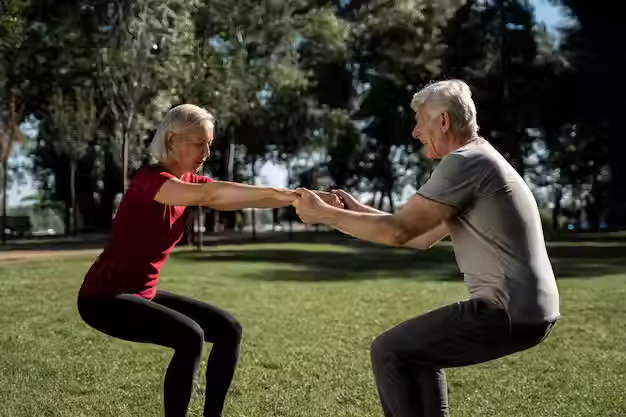
Functional fitness is exercise that trains your body for real life.
It focuses on movements you use every day:
Squatting down and standing up
Picking up groceries
Carrying laundry
Climbing stairs
Reaching overhead
Twisting and turning
Instead of isolating one muscle at a time, functional training strengthens movement patterns — improving balance, coordination, mobility, stability, and endurance simultaneously.
For adults in their 30s, 40s, 50s, 60s, and beyond, this style of training is one of the most powerful investments you can make in your long-term quality of life.
Why Functional Fitness Matters — Especially During Weight Loss
When patients begin GLP-1 therapy, they often experience reduced appetite and steady fat loss. That’s excellent.
However, without resistance-based movement:
You can lose muscle along with fat
Metabolism may slow over time
Energy levels can plateau
Joint stability may decline
Muscle is not just about appearance — it’s metabolic currency. It protects your joints, stabilizes your spine, supports blood sugar regulation, and preserves independence as you age.
Functional training helps preserve and build that muscle.
After age 30, we naturally begin losing muscle mass each decade. Without actively training against that decline, everyday tasks gradually become harder. Balance decreases. Injury risk rises. Fatigue increases.
The good news? The body responds to training at any age.
But the longer you wait, the steeper the climb.
Who Needs Functional Fitness?
If you are:
Sitting most of the day
Feeling more stiffness than you did five years ago
Getting winded climbing stairs
Avoiding certain movements because they “don’t feel great”
Relying on medication but not yet exercising
Then functional fitness isn’t optional.
It’s foundational.
Our clients here in Buffalo include busy professionals, parents, grandparents, and individuals rebuilding their health after years of putting themselves last. What they share is this:
They don’t just want to lose weight. They want to feel capable again.
You Don’t Need a Gym Full of Equipment
One of the biggest myths about strength training is that it requires complicated machines or intense programs.
You can begin with:
Bodyweight squats
Modified push-ups
Resistance bands
Light dumbbells or kettlebells
Loaded carries (even holding grocery bags)
Step-ups on stairs
Core stabilization exercises
Minimal equipment. Maximum return.
The goal isn’t perfection. The goal is consistency.
Setting Your Personal Standard
Functional fitness isn’t about comparing yourself to someone else. It’s about asking:
Can I squat and stand up without pain?
Can I carry half my bodyweight for 30–60 seconds?
Can I perform 10–15 controlled push-ups?
Can I balance on one leg for 30 seconds?
Can I move through my day without fear of strain?
If the answer is “not yet,” that’s not failure — that’s feedback.
Start where you are. Progress steadily. Reassess monthly.
Small improvements compound quickly.
Why There Is Some Urgency
Weight gain often happens gradually.
So does physical decline.
The difference is that decline accelerates when ignored.
Every year without strength training:
Muscle mass decreases
Bone density weakens
Metabolic flexibility declines
Balance worsens
The earlier you begin, the easier it is to protect your independence.
GLP-1 therapy can help you lose weight. Functional training helps you preserve strength, mobility, and resilience.
Together, they create sustainability.
The Bigger Picture: Quality of Life
Imagine:
Getting off the floor without effort
Traveling without fatigue
Playing confidently with your children or grandchildren
Preventing back pain instead of reacting to it
Feeling strong in your own body again
That’s what functional fitness offers.
And you don’t need to wait until you feel “ready.”
You become ready by starting.
The Path Forward
At our clinic, we believe in a comprehensive approach:
Medical support when appropriate (including GLP-1 therapy)
Strategic nutrition guidance
Strength-focused, functional movement
Long-term lifestyle change
Medication can initiate change. Movement sustains it. Lifestyle secures it.
If you are not currently exercising, consider this your sign.
Start with two to three short sessions per week. Use minimal equipment. Focus on movement quality. Build gradually.
Your future self — 10, 20, even 30 years from now — will thank you for beginning today.
Because weight loss is about more than a number on the scale.
It’s about building a body that supports the life you want to live.


Comments